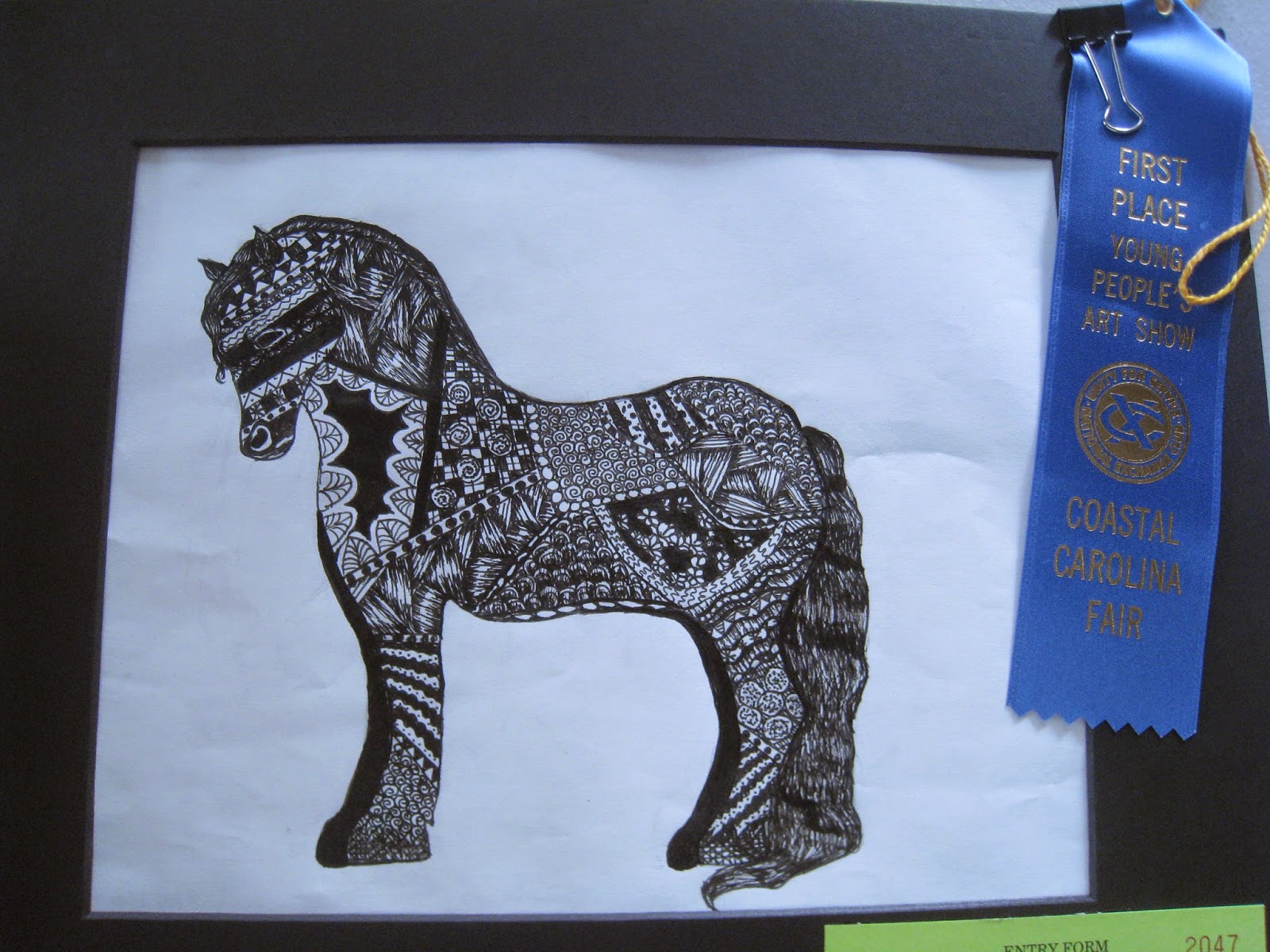
Looks like Max isn't the only winner. Dagny's horse won a blue ribbon at the county art fair ...
And here are a couple more noteworthy pieces. Dagny's best friend at school drew her mother using the photograph. It might have been taken 20 years ago, but she still looks the same! And Max made the bowl and Christmas tree in his ceramics class.
I find that the children used to spend hours drawing and experimenting. Now that they are older, their creative output is so much less. They play computer games or read the news or participate in social media ... I can't help but think they're swimming in the shallows. We routinely turn off everything so that they can reset (and just look at my own language -- it reflects how much the electronics have taken over my own life).
I will be ever grateful that we had some sense to keep all this away for the first decade of their lives so that they could develop their minds. We introduced the electronics in a limited way 4 yrs ago, but as they enter adolescence, we are letting them have full use and it's interesting (and dismaying and sad) to observe how quickly they discard the development of their own art in favor of becoming consumers. So we let them loose, and rein them in. And trying hard to cultivate a few good habits since the electronics are here to stay in their lives. But I mourn the loss of hours and hours of play. Even my own creative life thrives when I take the time to walk and observe all the beauty around me, listen to bird-song, play the piano, and write for no reason except to put words on paper or play with the arrangement of words. I often switch between different projects with poetry because it shakes things loose in my brain. I do not want the children to waste this wonderful time in their lives glued to a device in their *free time*. Now it's not all bad. It is the computer that has allowed us to play with pictures and make little home movies. But note the operative word: PLAY.
Parents, tell me, how do you strike a balance with your children?
Saturday, November 29, 2014
Tuesday, November 18, 2014
A Lizard's Tail
A LIZARD'S TAIL by Bish Denham: From the moment he hatches, Marvin P. Tinkleberry knows he is destined for greatness. For one, he has a marvelous, well-groomed tail. For another he can puff out his throat pouch in the most spectacular way. Maybe the other lizards in his colony don't take him seriously, but he knows the truth. It lives in the marrow of his bones; he's going to be a hero.
When a feral cat threatens the lives of all who live at Stone Wall in the Garden by the Sea, Marvin knows it's HIS destiny to get rid of the fearsome beast. Travelling Over the Hill to find help should be as easy as snapping up a sleeping moth. But it doesn't take long for Marvin to see that the world beyond Stone Wall is not the same as his pampered life back at the garden. From the deadly Sucker Cactus Forest to deadly mongooses, danger lurks around every corner and Marvin will have to decide if he's willing to be the hero he's long bragged about being.
I encountered Marvin P. Tinkleberry soon after I met Bish on the ICL boards. She mentioned she had a first draft of an animal story and I'm a sucker for animal stories so I offered to read. Wow! It was the best first draft I've ever read. All the advice you might ever have read about just getting the story down is spot on. This story seemed to pour out of Bish and Marvin was such a great character, I fell in love with him right away.
You can find A Lizard's Tail on Amazon. Bish is also the author of Anansi and Company: Retold JamaicanFolk Tales.
Bish Denham was raised in the U. S. Virgin Islands. Her mother's side of the family has lived in the Caribbean for over one hundred years and she still has plenty of family there whom she visits regularly. She says, "Growing up in the islands was like living inside a history book. Columbus named the islands, Sir Francis Drake sailed through the area, and Alexander Hamilton was raised on St. Croix. Then there were the pirates who plied the waters. Life for me was magical, and through my writing I hope to pass on some of that magic." Bish has known many lizards in her life. Marvin and Leeza are based on two that lived in her bedroom.
Saturday, November 15, 2014
A Cold Snap
My sweet clementines, my hot peppers! They aren't liking this cold snap one bit. Neither am I. This weekend we harvest everything.

Seventh and eighth graders got to go on a field trip to the Cotton Museum and a farm. I missed it because of Harry. Blasted Harry. But Dagny took some great pictures and I'm happy the kids had a wonderful time. I remember when Max went two years ago.

Dagny is developing a good eye for taking pictures. Here are some she took on her walk with the dog. Enjoy! The apple cake was delicious too ... she's an excellent cook as my growing girth will testify.


Saturday, November 8, 2014
It Can Wait Texting and Driving Winners!
I am so proud of all these boys for taking the initiative to spread the word on not texting and driving. You can read the full essay and watch the videos here: http://scpress.org/ItCanWait/
We got the news yesterday just before Max got home from school. I could see the smile on his face well before he got home ... he had his cell phone out. "Look up," I whispered. We had a great time reminiscing about all his writing adventures before he headed off to film a football game. He remembered how he wrote a 20-page story about magic basketball shoes in fourth grade. I remember how he wrote and wrote, with utter concentration. The assignment was for 2 pages and he didn't look up until he had about five pages. He remembered how much he liked the story he wrote about the Egyptian scribe, his first historical. We cracked up thinking about his salmon story, how the males fought before spawning. Suspense till the very end! And I remembered the story he wrote in first grade, where the twist was so great, I wanted to steal it for a magazine article. He's given me permission!
Ah, Max! I pray you live up to this essay. You bear a greater responsibility because you've been given much. You have the hand of God upon you. May you always let Him lead you.
Thursday, November 6, 2014
The Story of Ten Easter Eggs
Then a few years ago, I met a delightful novelty writer/illustrator on the Blueboards. She is a household name now -- Salina Yoon. We became friends and I asked whether she could take a look at my manuscript. She was incredibly gracious and suggested I tell the story in rhyme. At first, I was daunted. I'm not a poet. I can write a little poem once in a while. It is something I do to switch from fiction to nonfiction or vice versa. It's a way to play with words, shake things up. But a book in rhyme?!!! Could I pull it off? I took Salina's advice and found myself enjoying the process thoroughly. It was like a puzzle, chicks must do chicklet stuff in rhyme.
Ten eggs. All is quiet. Not a peep.
Nine eggs. One chick hatches. "Cheep, cheep, cheep."
And suddenly, I knew I'd hit gold. Kids will make their parents read this to them 500 times and the parents will not go crazy. Or maybe they will. I don't know. You tell me.
Last year, Debbie Ridpath Ohi posted on the Blueboards about her interview with Celia Lee, editor at Cartwheel books, and her open window of submission for about a month. I thought Ten Eggs would be perfect, so I spit-shined it and sent it off with a prayer. A few weeks later, I got a letter of interest. The rest is history and it's been most educational to learn how a novelty book is made. Celia always kept me in the loop and never minded the many questions I asked and the suggestions I made, but in the end, it's clear I'm just a writer, not an artist or engineer.
When I saw the layout and a sample illustration by Laura Logan, I was over the moon. I couldn't help but use adjectives like cute and darling and adorable.
My heartfelt thanks to my family and critters in WA who read all those iterations of TEE, Verla Kay for the Blueboards, Salina, Debbie, Laura and the entire team at Scholastic for making a dream that began a decade ago a reality. I am delighted.
I need to learn to write summaries like this (taken from the Scholastic website): In this sweet story, clever die-cuts, touchable plastic pieces, and fuzzy flocking all come together in a rhyming adventure all about Easter traditions. Follow and count along as ten quiet Easter eggs become ten colorful chicks ready to celebrate the holiday! A fun, engaging novelty story just right for the littlest of readers.
"This book begs to be touched," says Kirkus. Oh YESSSS! Read the full review.
Monday, November 3, 2014
On Recollection
Having dismissed the multitude, he went into a mountain alone to pray. ~ Matt. 14:23
October flew! We're coming to a quiet time in our lives and that's exactly what we need. We are enjoying eating dinner together without having to rush to volleyball practice or a football game. And Michael and I are back to strolling in the moonlight. He tells me the mosquitoes are gone but they bite me still. Sweet blood and all ...
Our little hamster died from old age, fat and happy, no diseases. Dagny had cleaned his cage and he was looking a bit tired as he clambered up to eat and wash himself. He made himself a little nest. The next morning we discovered he had passed on to a land of carrots and bananas, peanuts and sunflower seeds. It's strange to no longer save the rolls of empty tubes for him. He took great joy in tearing up the tissue, and we took joy in watching him. But, I'm supposed to be writing about St. Alphonsus' teaching on Recollection.
This was by far my favorite chapter so far. Everything resonated because I am living that life right now ... psst, you don't have to be a nun :) St. Alphonsus says, "To preserve recollection of spirit or the constant union of the soul with God, three things are necessary: solitude, silence, and the recollection of the presence of God.
"I will lead her into the wilderness and I will speak to her heart. Osee 2:14. God speaks to the soul in solitude, and by His words the heart is inflamed with divine love. My soul melted when my beloved spoke, said the spouse in the Canticle (5:6).
So, seek solitude, practice silence, and rest in God by keeping the thought of His presence ever before you."
The saint reminds us that it's not only solitude of the body that is important, but the solitude of the spirit. He says, "What benefit it is to live in the desert if the soul still clings to the things of the earth? Solitude of the heart consists in banishing from the heart all desires and inclinations that are not for God, and in performing our actions simply with God's good pleasure in view. The solitude of the heart consists in being able to say, "My God, Thee alone do I desire and nothing else."
I loved this because it reminds me that although I live in this world, I do not have to be attached to it.
The saint exhorts us not to be idle. "It is not to be supposed that solitude and retirement are synonymous with idleness. Many live in retirement, but it is an inactive and useless retirement of which they shall have to render an account. Devout souls, on the contrary, are like bees that are never tired preparing honey for their cells. No time must be lost, but every moment employed in prayer, in reading, or in performing the duties of your state in life."
St. Alphonsus extols the virtues of work. "Work is an effective remedy against temptations. While our hands are occupied with external occupations, our heart can be fixed on God. The good intention we make in performing our labors sanctifies them in the sight of God and even makes labor a prayer, for prayer has been called the raising of the mind and heart to God.
"Those who have the spirit of prayer love silence, which has deservedly been called a protectress of innocence, a shield against temptations and a fruitful source of prayer. Silence promotes recollection and awakens good thoughts in the heart. Silence preserves us from many sins by removing the occasion of uncharitable talk, rancor and curiosity; on the other it aids us in the attainment of many virtues, like humility and meekness."
The saint reminds us that remembering the presence of God is an excellent means of "quieting the passions and of resisting temptations to sin ... Men fall into sin because they lose sight of the presence of God. It was the thought of God that gave the chaste Susanna courage to spurn the wicked advances of the men who tried to seduce her and even threatened her with death. She said, It is better for me to fall into your hands without doing evil, than to sin in the sight of the Lord. Dan 13:23.
"Union of the soul with God is the third happy result of walking constantly in His presence. Love is always strengthened by the presence of the object loved. In order to remain intimately united to God, it is not sufficient to make a morning and evening meditation. If you remove boiling water from the stove, it will soon cool off. And so it is with the human soul; to keep the fire of God's love aglow, the thought of His presence must be constantly before us."
As always, St. Alphonsus gives practical suggestions to practice the virtues. He says, "picture our Lord as present with us wherever we may be. We may think of Him at times as a little babe in the crib of Bethlehem; as a poor exile on His way to Egypt; as an apprentice in the workshop of Nazareth; a man of sorrows who was condemned a criminal to suffer and die; as scourged and crowned and crucified. One needn't strain the imagination, which is apt to be very fatiguing and might possibly be injurious." (I had to include this last bit because it makes me laugh. I suppose for us writers, this exercise is not at all strenuous.)
"Another way is based on the truths of holy faith. It consists of seeing God with the eyes of faith and being thoroughly persuaded that He is present and a witness of our actions. It matters not that we are unable to see Him with our bodily eyes; we cannot see the air around us, and we never doubt for a moment that it exists and that without it we could not possibly live. It is sufficient to make little acts of faith.
"Another beautiful practice is that of seeing God in His creatures. The beauties of nature such as the rising and setting of the sun, a magnificent landscape, a majestic river, a garden of beautiful flowers are so many reflexes of the beauty of the Creator. The thought of a learned or handsome or holy man can lead us to admire the wisdom and beauty and sanctity of God and return Him thanks for permitting His creatures to share in His holy attributes.
"The most perfect method, however, of keeping alive the thought of God's presence consists in beholding God within our very selves. It is not necessary to ascend to Heaven to find the Lord God; we need only to recollect ourselves, and we shall find Him within us. St. Paul says, Know you not, that you are the temple of God, and that the Spirit of God dwelleth in you? 1 Cor 3:16. And our Divine Savior Himself has said, If anyone love me, he will keep my word, and my Father will love him, and we will come to him and make our abode with him. John 14:23.
October flew! We're coming to a quiet time in our lives and that's exactly what we need. We are enjoying eating dinner together without having to rush to volleyball practice or a football game. And Michael and I are back to strolling in the moonlight. He tells me the mosquitoes are gone but they bite me still. Sweet blood and all ...
This was by far my favorite chapter so far. Everything resonated because I am living that life right now ... psst, you don't have to be a nun :) St. Alphonsus says, "To preserve recollection of spirit or the constant union of the soul with God, three things are necessary: solitude, silence, and the recollection of the presence of God.
"I will lead her into the wilderness and I will speak to her heart. Osee 2:14. God speaks to the soul in solitude, and by His words the heart is inflamed with divine love. My soul melted when my beloved spoke, said the spouse in the Canticle (5:6).
So, seek solitude, practice silence, and rest in God by keeping the thought of His presence ever before you."
The saint reminds us that it's not only solitude of the body that is important, but the solitude of the spirit. He says, "What benefit it is to live in the desert if the soul still clings to the things of the earth? Solitude of the heart consists in banishing from the heart all desires and inclinations that are not for God, and in performing our actions simply with God's good pleasure in view. The solitude of the heart consists in being able to say, "My God, Thee alone do I desire and nothing else."
I loved this because it reminds me that although I live in this world, I do not have to be attached to it.
The saint exhorts us not to be idle. "It is not to be supposed that solitude and retirement are synonymous with idleness. Many live in retirement, but it is an inactive and useless retirement of which they shall have to render an account. Devout souls, on the contrary, are like bees that are never tired preparing honey for their cells. No time must be lost, but every moment employed in prayer, in reading, or in performing the duties of your state in life."
St. Alphonsus extols the virtues of work. "Work is an effective remedy against temptations. While our hands are occupied with external occupations, our heart can be fixed on God. The good intention we make in performing our labors sanctifies them in the sight of God and even makes labor a prayer, for prayer has been called the raising of the mind and heart to God.
"Those who have the spirit of prayer love silence, which has deservedly been called a protectress of innocence, a shield against temptations and a fruitful source of prayer. Silence promotes recollection and awakens good thoughts in the heart. Silence preserves us from many sins by removing the occasion of uncharitable talk, rancor and curiosity; on the other it aids us in the attainment of many virtues, like humility and meekness."
The saint reminds us that remembering the presence of God is an excellent means of "quieting the passions and of resisting temptations to sin ... Men fall into sin because they lose sight of the presence of God. It was the thought of God that gave the chaste Susanna courage to spurn the wicked advances of the men who tried to seduce her and even threatened her with death. She said, It is better for me to fall into your hands without doing evil, than to sin in the sight of the Lord. Dan 13:23.
"Union of the soul with God is the third happy result of walking constantly in His presence. Love is always strengthened by the presence of the object loved. In order to remain intimately united to God, it is not sufficient to make a morning and evening meditation. If you remove boiling water from the stove, it will soon cool off. And so it is with the human soul; to keep the fire of God's love aglow, the thought of His presence must be constantly before us."
As always, St. Alphonsus gives practical suggestions to practice the virtues. He says, "picture our Lord as present with us wherever we may be. We may think of Him at times as a little babe in the crib of Bethlehem; as a poor exile on His way to Egypt; as an apprentice in the workshop of Nazareth; a man of sorrows who was condemned a criminal to suffer and die; as scourged and crowned and crucified. One needn't strain the imagination, which is apt to be very fatiguing and might possibly be injurious." (I had to include this last bit because it makes me laugh. I suppose for us writers, this exercise is not at all strenuous.)
"Another way is based on the truths of holy faith. It consists of seeing God with the eyes of faith and being thoroughly persuaded that He is present and a witness of our actions. It matters not that we are unable to see Him with our bodily eyes; we cannot see the air around us, and we never doubt for a moment that it exists and that without it we could not possibly live. It is sufficient to make little acts of faith.
"The most perfect method, however, of keeping alive the thought of God's presence consists in beholding God within our very selves. It is not necessary to ascend to Heaven to find the Lord God; we need only to recollect ourselves, and we shall find Him within us. St. Paul says, Know you not, that you are the temple of God, and that the Spirit of God dwelleth in you? 1 Cor 3:16. And our Divine Savior Himself has said, If anyone love me, he will keep my word, and my Father will love him, and we will come to him and make our abode with him. John 14:23.
Tuesday, October 28, 2014
Reading
Girls Like Us by Gail Giles
I have not read very many books where the narrator is developmentally challenged. I've only read one other MG book. It is far easier to let a sibling or friend tell the story. I had toyed with having alternating viewpoints in my own contemporary novel, but sustaining the voice of the intellectually impaired sister was difficult. In the end, her voice comes through clear and true through dialogue and I stuck with a single viewpoint, that of the sister who is ... for lack of a better term, normal. Except she's not. Ms. Giles has written a powerful story about two girls, Biddy and Quincy, who transition to living independently once they turn 18, the prejudices and hardships they face just because they are "speddies" and their hopes and dreams of the future. I found myself cheering them on for facing obstacles and crying with them when they were hurt. Giles left them in a good place, but I couldn't help but worry for them long after I finished the book. These characters will remain with me always.
Impossible by Nancy Werlin
This was one of the most romantic books I've read in a long time. Based on the song, Scarborough Fair, the author weaves a tale involving a family curse and the love that breaks it. I loved the contemporary setting with a great cast of characters who race against time to solve the puzzle. As it says on the cover: a haunting, thrilling romantic puzzle. Just read it.
By the way, this book breaks many so-called writing rules. It has a prologue, multiple viewpoints, some by adult characters, mixing of genres ... but it's also brilliant. Anyway, just a reminder to write what the story demands.
True Grit by Charles Portis
This is probably the first old Western I've read. I enjoyed it tremendously. It speaks of a world where one is beginning to create law. By far, the 14-year-old Mattie has the strongest sense of justice. Loved her voice. This is a book appropriate for children and adults alike, a true American classic.
The Mirror by Marlys Millhiser
I have always enjoyed time travel stories but this one was very unique with body-swapping as well. Shay, a 20-yr old girl, stares into her grandmother's mirror on the eve of her wedding and is transported into her grandmother's body (Brandy) on the eve of her wedding. Shay-as-Brandy even gives birth to her own mother. Now think about that ... all the conundrums it causes, foreknowledge, etc. A really fun read.
The Ten Commandments by Msgr. Charles Pope
A concise little book by one of my favorite preachers. Fr. Pope shows how the commandments apply to daily life, how they free us to love God and our neighbor as we ought. It also has a good examination of conscience.
Defending Marriage: Twelve Arguments for Sanity by Anthony Esolen
This is one of my favorite authors. I always look forward to his clear reflections in the Magnificat, and he does not disappoint in this book. In the Family Honor class Dagny and I just took, the last skit was about a couple who gets married and has a lot of baggage. They came to the altar broken. That's not to say that the grace of God cannot work in them ... Michael and I are prime examples of a couple who went through heartbreak and betrayal before we were married and who went on to make numerous mistakes, but we have finally come to the Truth and how it resonates in our hearts. Holy Matrimony: a covenant between one man and one woman, holy because it is set apart from any other kind of relationship; it makes us co-creators with God. The author makes arguments for traditional marriage not just because God meant it to be so, but through the lens of history, literature, and plain old common sense. This is a beautifully written book, perfect as supplemental material for marriage preparation classes.
The Gift of Living in the Divine Will in the Writings of Luisa Piccarreta by Fr. Joseph Iannuzzi
I'm smack dab in the middle of this book when my kindle freezes up and I am not reading this on the computer screen. I tried deleting this a dozen times and reloading and finally, after a week, it is working. This is the first instance of a kindle snafu. Still, it is a difficult book to read on the kindle. I often want to go back and look up something and unless I bookmark the sections, it is difficult to find. But this book is incredible in what it proposes, that we are coming into a new era where God is bestowing gifts that only Adam and Eve received before their fall from grace. Mary was the last human on earth before Luisa to receive the gift of living in the Divine Will. Much of this stuff I cannot wrap my head around, but it is making me understand my faith in a deeper way.
Christianity, Islam and Atheism: the Struggle for the Soul of the West by William Kilpatrick.
This is a must-read for people who are interested in what is occurring in the Middle East -- the persecution of Christians. I grew up knowing about all the world's major religions and believe me, they are not the same! Many people in the West simply do not understand that Islam is not tolerant of any other faith. Infidels are to be converted or killed. This is why we had the Crusades.
I wish we had a leader like Winston Churchill who wanted to stir the hearts of the British people to make war against Germany. He said:
We have before us an ordeal of the most grievous kind. We have before us many, many long months of struggle and of suffering. You ask, what is our policy? I will say: It is to wage war, by sea, land and air, with all our might and with all the strength that God can give us; to wage war against a monstrous tyranny, never surpassed in the dark and lamentable catalogue of human crime. That is our policy. You ask, what is our aim? I can answer in one word: victory; victory at all costs, victory in spite of all terror, victory, however long and hard the road may be; for without victory, there is no survival.
I think that's enough for now ... Tell me, what good books are you reading right now.
I have not read very many books where the narrator is developmentally challenged. I've only read one other MG book. It is far easier to let a sibling or friend tell the story. I had toyed with having alternating viewpoints in my own contemporary novel, but sustaining the voice of the intellectually impaired sister was difficult. In the end, her voice comes through clear and true through dialogue and I stuck with a single viewpoint, that of the sister who is ... for lack of a better term, normal. Except she's not. Ms. Giles has written a powerful story about two girls, Biddy and Quincy, who transition to living independently once they turn 18, the prejudices and hardships they face just because they are "speddies" and their hopes and dreams of the future. I found myself cheering them on for facing obstacles and crying with them when they were hurt. Giles left them in a good place, but I couldn't help but worry for them long after I finished the book. These characters will remain with me always.
Impossible by Nancy Werlin
This was one of the most romantic books I've read in a long time. Based on the song, Scarborough Fair, the author weaves a tale involving a family curse and the love that breaks it. I loved the contemporary setting with a great cast of characters who race against time to solve the puzzle. As it says on the cover: a haunting, thrilling romantic puzzle. Just read it.
By the way, this book breaks many so-called writing rules. It has a prologue, multiple viewpoints, some by adult characters, mixing of genres ... but it's also brilliant. Anyway, just a reminder to write what the story demands.
True Grit by Charles Portis
This is probably the first old Western I've read. I enjoyed it tremendously. It speaks of a world where one is beginning to create law. By far, the 14-year-old Mattie has the strongest sense of justice. Loved her voice. This is a book appropriate for children and adults alike, a true American classic.
The Mirror by Marlys Millhiser
I have always enjoyed time travel stories but this one was very unique with body-swapping as well. Shay, a 20-yr old girl, stares into her grandmother's mirror on the eve of her wedding and is transported into her grandmother's body (Brandy) on the eve of her wedding. Shay-as-Brandy even gives birth to her own mother. Now think about that ... all the conundrums it causes, foreknowledge, etc. A really fun read.
The Ten Commandments by Msgr. Charles Pope
A concise little book by one of my favorite preachers. Fr. Pope shows how the commandments apply to daily life, how they free us to love God and our neighbor as we ought. It also has a good examination of conscience.
Defending Marriage: Twelve Arguments for Sanity by Anthony Esolen
This is one of my favorite authors. I always look forward to his clear reflections in the Magnificat, and he does not disappoint in this book. In the Family Honor class Dagny and I just took, the last skit was about a couple who gets married and has a lot of baggage. They came to the altar broken. That's not to say that the grace of God cannot work in them ... Michael and I are prime examples of a couple who went through heartbreak and betrayal before we were married and who went on to make numerous mistakes, but we have finally come to the Truth and how it resonates in our hearts. Holy Matrimony: a covenant between one man and one woman, holy because it is set apart from any other kind of relationship; it makes us co-creators with God. The author makes arguments for traditional marriage not just because God meant it to be so, but through the lens of history, literature, and plain old common sense. This is a beautifully written book, perfect as supplemental material for marriage preparation classes.
The Gift of Living in the Divine Will in the Writings of Luisa Piccarreta by Fr. Joseph Iannuzzi
I'm smack dab in the middle of this book when my kindle freezes up and I am not reading this on the computer screen. I tried deleting this a dozen times and reloading and finally, after a week, it is working. This is the first instance of a kindle snafu. Still, it is a difficult book to read on the kindle. I often want to go back and look up something and unless I bookmark the sections, it is difficult to find. But this book is incredible in what it proposes, that we are coming into a new era where God is bestowing gifts that only Adam and Eve received before their fall from grace. Mary was the last human on earth before Luisa to receive the gift of living in the Divine Will. Much of this stuff I cannot wrap my head around, but it is making me understand my faith in a deeper way.
Christianity, Islam and Atheism: the Struggle for the Soul of the West by William Kilpatrick.
This is a must-read for people who are interested in what is occurring in the Middle East -- the persecution of Christians. I grew up knowing about all the world's major religions and believe me, they are not the same! Many people in the West simply do not understand that Islam is not tolerant of any other faith. Infidels are to be converted or killed. This is why we had the Crusades.
I wish we had a leader like Winston Churchill who wanted to stir the hearts of the British people to make war against Germany. He said:
We have before us an ordeal of the most grievous kind. We have before us many, many long months of struggle and of suffering. You ask, what is our policy? I will say: It is to wage war, by sea, land and air, with all our might and with all the strength that God can give us; to wage war against a monstrous tyranny, never surpassed in the dark and lamentable catalogue of human crime. That is our policy. You ask, what is our aim? I can answer in one word: victory; victory at all costs, victory in spite of all terror, victory, however long and hard the road may be; for without victory, there is no survival.
![]() |
| St. Francis and the Sultan (1300s) Cappella Bardi, Basilica di Santa Croce, Florence |
I think that's enough for now ... Tell me, what good books are you reading right now.
Wednesday, October 22, 2014
Sacred Fire
I've been reading a ton of books but I wanted to review Sacred Fire: Practicing Devotion to the Heart of Jesus by Philip Michael Bulman by itself since I have many thoughts on it. And also because it's the Feast of Saint John Paul II the Great!!!
Sacred Fire is the second book I’ve read on the Sacred Heart; the first one being a classic by Fr. John Croiset, the spiritual director of St. Margaret Mary Alacoque (1647-1690). However, I wish I’d gotten my hands on Bulman’s book first because it’s much easier to read.
The first part of the book traces the evolution of this devotion beginning with St. Gertrude (1256-1302), who not only had visions of Jesus but also of St. John the Evangelist! On his feast day, she asked why he had not written more plainly about the Sacred Heart in his Gospel, given that he rested upon the breast of Jesus at the Last Supper. St. John said that such "revelations about the Sacred Heart had been reserved until later ages, that the world might be aroused from its torpor, and animated, when it had grown cold, by hearing of these things."
Wow! It makes me want to get her works. And this is the beauty of Bulman's book. With each saint who was given some revelation about the Sacred Heart, it makes me want to dig deeper, so that I too may have the pleasure of being enclosed within His Heart.
And this is the way Bulman traces the history of this devotion. The last two sentences of the chapter on St. Gertrude are: A French edition of Gertrude's Legatus was published in 1671. It is possible the book was read aloud in an obscure convent in Paray-le-Monial, where a young woman named Margaret Mary Alacoque had recently become a novice.
Bulman follows St. Margaret Mary, who popularized devotion to the Sacred Heart, then the various Carmelite nuns who picked it up. St. Therese's Story of a Soul fell into the hands of Teresa of the Andes, and ends with modern-day St. Faustina, whom St. John Paul II canonized, the first saint of the new millennium. It is this continuity that makes Sacred Fire such a joy to read.

The second half of the book deals with the actual devotion, its Scriptural roots, and the promises of the Sacred Heart. Fisheaters has an excellent summary. Briefly, one must receive Holy Eucharist frequently, keep a Holy Hour on Thursday night, attend the Holy Sacrifice of the Mass on first Fridays of the months as a reparation not just for our own sins but the sins of the world, and celebrate the Feast of the Sacred Heart. This means, one must go for confession frequently as well :) Just sayin'
I remember our priest exhorting us to devote ourselves to the Sacred Heart because It is the fount of all graces. Catholics are often shown with the rosary, but as anybody who prays the rosary knows, Mary takes hold of us and brings us to Jesus. We'll be celebrating our second anniversary of consecration of our family to the Sacred Heart of Jesus on Nov. 9th. I am so very grateful for this book that has brought a greater love and understanding. Thank you, Mr. Bulman, for writing a very important book.
A happy Feast day to all.
Pray for us, Saint John Paul II.
Sacred Fire is the second book I’ve read on the Sacred Heart; the first one being a classic by Fr. John Croiset, the spiritual director of St. Margaret Mary Alacoque (1647-1690). However, I wish I’d gotten my hands on Bulman’s book first because it’s much easier to read.
The first part of the book traces the evolution of this devotion beginning with St. Gertrude (1256-1302), who not only had visions of Jesus but also of St. John the Evangelist! On his feast day, she asked why he had not written more plainly about the Sacred Heart in his Gospel, given that he rested upon the breast of Jesus at the Last Supper. St. John said that such "revelations about the Sacred Heart had been reserved until later ages, that the world might be aroused from its torpor, and animated, when it had grown cold, by hearing of these things."
Wow! It makes me want to get her works. And this is the beauty of Bulman's book. With each saint who was given some revelation about the Sacred Heart, it makes me want to dig deeper, so that I too may have the pleasure of being enclosed within His Heart.
And this is the way Bulman traces the history of this devotion. The last two sentences of the chapter on St. Gertrude are: A French edition of Gertrude's Legatus was published in 1671. It is possible the book was read aloud in an obscure convent in Paray-le-Monial, where a young woman named Margaret Mary Alacoque had recently become a novice.
Bulman follows St. Margaret Mary, who popularized devotion to the Sacred Heart, then the various Carmelite nuns who picked it up. St. Therese's Story of a Soul fell into the hands of Teresa of the Andes, and ends with modern-day St. Faustina, whom St. John Paul II canonized, the first saint of the new millennium. It is this continuity that makes Sacred Fire such a joy to read.
I remember our priest exhorting us to devote ourselves to the Sacred Heart because It is the fount of all graces. Catholics are often shown with the rosary, but as anybody who prays the rosary knows, Mary takes hold of us and brings us to Jesus. We'll be celebrating our second anniversary of consecration of our family to the Sacred Heart of Jesus on Nov. 9th. I am so very grateful for this book that has brought a greater love and understanding. Thank you, Mr. Bulman, for writing a very important book.
A happy Feast day to all.
Pray for us, Saint John Paul II.
Monday, October 13, 2014
On Being a Vegetarian and World History
My daughter, who occasionally goes through phases where she says she's a vegetarian got this tee-shirt for her dad's birthday. Of course, all he has to do is cook some steak or ribs ... and the phase is over.
Every time Michael wears this shirt, I am reminded of this hilarious essay. I do not know who the author is, but if you know, please let me know in the comments:
For those that don't know about history ... Here is a condensed version:
Humans originally existed as members of small bands of nomadic hunters/gatherers. They lived on deer in the mountains during the summer and would go to the coast and live on fish and lobster in the winter.
The two most important events in all of history were the invention of beer and the invention of the wheel. The wheel was invented to get man to the beer. These were the foundation of modern civilization and together were the catalyst for the splitting of humanity into two distinct subgroups:
1 . Liberals, and
2. Conservatives.
Once beer was discovered, it required grain and that was the beginning of agriculture. Neither the glass bottle nor aluminum can were invented yet, so while our early humans were sitting around waiting for them to be invented, they just stayed close to the brewery. That's how villages were formed.
Some men spent their days tracking and killing animals to B-B-Q at night while they were drinking beer. This was the beginning of what is known as the Conservative movement.
Other men who were weaker and less skilled at hunting learned to live off the conservatives by showing up for the nightly B-B-Q's and doing the sewing, fetching, and hair dressing. This was the beginning of the Liberal movement.
Some of these liberal men eventually evolved into women. Those became known as girlie-men. Some note worthy liberal achievements include the domestication of cats, the invention of group therapy, group hugs, and the concept of Democratic voting to decide how to divide the meat and beer that conservatives provided.
Over the years conservatives came to be symbolized by the largest, most powerful land animal on earth, the elephant. Liberals are symbolized by the jackass.
Modern liberals like imported beer (with lime added), but most prefer white wine or imported bottled water. They eat raw fish but like their beef well done. Sushi, tofu, and French food are standard liberal fare. Another interesting evolutionary side note: most of their women have higher testosterone levels than their men. Most social workers, personal injury attorneys, journalists, dreamers in Hollywood and group therapists are liberals. Liberals invented the designated hitter rule because it wasn't fair to make the pitcher also bat.
Conservatives drink domestic beer, mostly Bud or Miller.They eat red meat and still provide for their women. Conservatives are big game hunters, rodeo cowboys, lumberjacks, construction workers, firemen, medical doctors, police officers, engineers, corporate executives, athletes, members of the military, airline pilots and generally anyone who works productively.
Conservatives who own companies hire other conservatives who want to work for a living.
Liberals produce little or nothing. They like to govern the producers and decide what to do with the production. Liberals believe Europeans are more enlightened than Americans. That is why most of the liberals remained in Europe when conservatives were coming to America . They crept in after the Wild West was tamed and created a business of trying to get more for nothing.
Here ends today's lesson in world history:
It should be noted that a Liberal may have a momentary urge to angrily respond to the above.
A Conservative will simply laugh.
And there you have it, History 101.
Thursday, October 9, 2014
On Angels and Demons: Notes from ME Conference Part II
Of all the lectures, I enjoyed those of Fr. Joseph Leo Iannuzzi the most because I learned so many new and interesting things. He did his doctoral dissertation on Living in the Divine Will. It is a private revelation* given to a mystic, Servant of God Luisa Piccarreta.
I've begun reading this tome (without my hand getting tired, thanks to my kindle) and simply fascinated by her life. She lived on only the Eucharist for 60 years! Although bedridden, she had no sores. Only after a priest would bless her could she be propped up to write (she was ordered to do so once they figured out her condition wasn't normal, that she was having visions). She was in good health until she contracted pneumonia at the age of 80, when she died. She was a contemporary of Padre Pio and he read her visions as well. I am so thankful her little pamphlets caught the eyes of Fr. Iannuzzi. He has not only translated her writings but also given a larger context. It truly is amazing how God chooses a lowly woman to reveal Himself and a humble priest to bring it to the world. God bless you, Father.
Fr. Iannuzzi covered a great deal of theology about angels and the fall of man. Some things to know about angels. They possess a far greater intellect than we can imagine. They can see the consequences of all their actions (it reminded me of the character in Men in Black III who could calculate all possibilities and thus make the correct decision) and this is why they cannot be forgiven if they do not choose God. Every creature is tested before entry into heaven and the angels had individual tests. Those that passed can no longer sin. They are with God. Those that didn't joined Lucifer. This angel of Light rebelled against the foreknowledge of God being incarnated as a human, a creature with an intellect far below those of angels. I will not serve, he said. Lucifer enters the garden to stop the Incarnation.
It is a mystery why God allows temptation but had Adam corrected Eve, we'd still be sinless. Adam would've been the prince of the human race, Christ, the King. But Adam loved Eve more than he loved God. Jesus tells Luisa that before the fall, they both lived in the Divine Will. After the fall, you can see there is an immediate correlation between natural disasters and diseases -- all creation groans from the sin of Adam.
Jesus is the new Adam. He lived in the Divine Will. He was tempted and tested in the desert. But it wasn't over. He was tempted and tested again on the Cross. It was His complete obedience to the Father that set us free from sin and death and the power of Satan.
Since you've stuck with me so far, I'll share a Catholic joke Father told. Why did Mary and Joseph take a donkey to Bethlehem?
Because she gave her Fiat to God.
To learn more about living in the Divine Will, please see http://www.ltdw.org/.
Fr. Iannuzzi spoke at great length about other visions of Luisa that shed light on salvation history but I want to share some notes on his second lecture on Spiritual Warfare and Demonology without resorting to Part III. While he was in Rome, he assisted the Vatican's Chief Exorcist, Fr. Gabriele Amorth. So ...
No one is exempt from Satan.
A story: A man tells his wife to not buy anything expensive but she comes home with a gorgeous red dress, with a hefty price tag. When the husband sputtered about it, she said, "It was like Satan whispering that I'll look good in it so I just wanted to try it on."
"Then why didn't you tell him to get behind you?" said the husband.
"I did," said the wife, "and he said it's fabulous."
Nowadays, most people don't think much of Satan or believe in his existence. We've lost our horror of sin. If you've read the Screwtape Letters by CS Lewis, you already know this is one of Satan's strategies. Because now he can move around without being detected. But Satan is real and so is hell and as much as we'd like to believe that it is empty, the many saints who did have visions, saw hell populated, and among them priests ... priests who led their flock astray. St. Teresa de Avila always cracks me up even when she is serious, with her sorrow for especially the Lutherans.
God allows Adam to be tested. He fails; sin and death enter the world. But God sends his Son -- Jesus Christ -- to save us and to destroy the work of the devil. The faith of our parents saves us. We are like the paralytic, bound in sin. They bring us to the baptismal font and baptism begins the work of sanctification. At baptism, we receive the gifts of faith, hope and love. Through practice, these gifts grow in us. But it's not a free pass ... concupiscence remains even after baptism. It takes work on our part to grow in holiness and the outpouring of grace from God. And as we all know, it's not easy, the work part. We fall again and again. I tell you, the Church is a great hospital for sinners. I know, because I am a sinner, and without a sacramental life, I would fall deeper and deeper into sin. Jesus saves ... again and again, in the sacrament of confession and by feeding me Himself.
Satan is always prowling about like a lion, ready to pounce upon us. But Jesus taught the Apostles to cast out demons in His name. It is a direct and solemn command that we can use as well.
Problem is that Satan doesn’t leave us alone. In Matt 12:45 we learn that the evil spirit “goes and brings back with itself seven other spirits more evil than itself, and they move in and dwell there; and the last condition of that person is worse than the first. Thus it will be with this evil generation.” That’s why exorcisms have to be performed multiple times.
Did you know that confession is actually an exorcism? Fr. Iannuzzi said that repressed mortal sins are often the cause of severe depression and other physical ailments that defy medical explanation. After prayers and absolution the person is often miraculously healed. The Sacrament of Healing, which I have received a few times for severe migraines, is also an exorcism. I gain 50% reduction that lasts a good 6-8 months that no physician can explain. It's better than even the placebo effect (which is typically 30%). I am much better now since I started my treatment on low-dose beta blockers, but I am still susceptible, like the weekend of the conference. I have been purified through this suffering and no longer afraid of any attacks because I know I can offer it up. I would never choose it, however. I’m still too weak and always prefer not to sacrifice.
An interesting tidbit: evil spirits reside in arid places. There are several references to this in the Bible, the most famous one being that Jesus went to the desert to fast and pray and there he was tempted. The early Church Fathers went to the desert to combat Satan too.
Another interesting tidbit: The Latin Rite is more effective for casting out demons.
But we can use any language to do simple exorcisms, to heal the family tree, free ourselves from hauntings or involvement of the occult.
There are three parts:
1. Prayer – of liberation, praise, thanksgiving, intercession, and in tongues (this is where the Holy Spirit takes over). Of all these prayers, the prayers of praise are the most powerful. Satan hates for us to praise and thank God.
2. Word of God – read Psalms and the Gospel with conviction. Believe!
3. Command the evil spirits – to leave, and to never return in the name of Jesus. You can command them to go to the foot of the Cross or to hell.
A person has to go through a thorough physical, mental and spiritual evaluation when demons are suspected. Fr. Iannuzzi said that people who are possessed have these signs: chronic depression, repugnance to holy objects and prayers, resentment, levitation, extraordinary physical strength, violent, knowledge that the person wouldn’t normally have.
Confession, Mass, Adoration, Exorcism, Litany of Saints, Crucifix, blessed salt, oil, Holy Water, profession of baptismal promises are the tools of the trade. Father said it takes on average 3 years to cleanse the person from evil.
After all the stories Fr. Iannuzzi shared, I was surprised that he’s not a scaredy-cat priest. Au contraire. He is calm and funny, a man at peace and without fear. Jesus is his Rock.
He said that Satan can enter your memory and intellect without your consent, but he cannot enter your will without your consent. And God allows Satan to test you. Resisting temptations make you stronger. This is why it is imperative you live in the Divine Will.
Our Father, who art in Heaven, hallowed be Thy Name.
Thy Kingdom come, Thy will be done on earth as it is in heaven.
Give us this day our Daily Bread and forgive us our trespasses as we forgive those who trespass against us.
And lead us not into temptation, but deliver us from evil. Amen.
Hail Mary, full of grace, the Lord is with Thee. Blessed are thou amongst women and blessed is the Fruit of thy womb, Jesus.
Holy Mary, Mother of God, pray for us sinners, now and at the hour of our death.
Glory be to the Father, and to the Son, and to the Holy Ghost, as it was in the beginning, is now, and ever shall be, world without end. Amen.
| Michelangelo: Last Judgment |
*A note on visionaries: Catholics are not required to believe any private revelation, even if it has the imprimatur of the Church.
Subscribe to:
Posts (Atom)


