Friday, September 30, 2016

Pets in Heaven?


I've been thinking about this a lot. I've often thought that I could never be happy without a cat, so I assume that our dearly beloved pets will be in heaven to greet us when we finally get there. I think of the passage about the lion lying down with the lamb and surely I think that in the new Jerusalem, we shall all be as we were meant to be. Perfect. With our perfect pets.

But, but, but ... perhaps I will not be ready for heaven if I have this great attachment to my cats. One thing I've been learning because of the chronic migraines (which are greatly reduced in number thanks to the Botox treatment) is letting go of attachments, even my attachment to this earthly life, all its pleasures. And if I cannot let go, I'm thinking I'll be spending a very long time in purgatory.  

What I keep coming back to is: Seek ye first the kingdom of God, and His righteousness; and all these things shall be added unto you. (Matt 6:33).

What are your thoughts on this?

Also, although we cannot judge the state of any soul, we can certainly judge their actions and if they seem like they're on the road to hell, do you wonder whether you could be happy in heaven if a loved one isn't there? Does that mean you are not ready for heaven? I'm thinking again about attachments, how much letting go I need to do. I know there are no tears in heaven. Besides, a person who hates God wouldn't want to be in heaven. What I need to do is trust in God's perfect mercy and justice. 

ETA this quote from the Little Flower because I don't want to forget it.


Wednesday, September 28, 2016

September Birthday Celebrations


We have a lot of Sept. birthdays in both our families. This is Michael as a 4 mo. old. Reminds me a lot of Max with his rolls of fat! Love, love, love the gift of old pictures. My beautiful mother-in-law sent these as a gift. It was great remembering our youth.


Monday, September 26, 2016

Feast of our North American Martyrs

We were first introduced to the traditional Latin Mass at the North American Martyrs FSSP parish in Seattle. I love how they've grown! Check out their new website and beautiful photographs. If you keep scrolling down, you'll see a brief history of the martyrs. Detailed biography here. Today is the combined feast days of: Saint Rene Goupil, Saint Isaac Jogues, Saint John de Lalande, Saint Anthony Daniel, Saint John de Brebeuf, Saint Gabriel Lalemant, Saint Charles Garnier, Saint Noel Chabanel.
 
Protect our land, O heavenly patrons, which you have bedewed with the rich treasure of your blood. Watch over our Catholic Faith which you helped to establish in this new land. Bring all our fellow citizens to a knowledge and love of the truth. Make us zealous in spreading abroad a knowledge of Catholic teachings, so that we may continue and perfect the work which you have begun with so much labor and suffering. Pray for our homes, our schools, our missions; for vocations, for the conversion of sinners, the return of those who have wandered from the fold, and the perseverance of all the faithful. Amen.

Saturday, September 24, 2016

Writing with Kittens

Many of you have seen these pictures on FB given that I cannot resist sharing kitten pictures, but I know many of you don't have FB accts (and it's probably a good thing because there's a lot of stuff that comes into the feed and I'm still learning how to manage it). But FB is entertaining as well -- I've come across piano playing, kitten antics, devoted doggies, Catholic beauty and more.

But onto the kittens. They are growing beautifully. Benny is a little guy, only 4 lbs but he can hold his own against Jules who is 6 lbs. They're still afraid of people they don't know (they always hide when we have guests) but they know that we bring them food and treats and pets. They own us. Best of all, they follow me around everywhere just like our dog. And at night, they scuffle for a spot on me. Max says they are truly my cats. And he's right. After all, he's going to be leaving home in a year. Sniff. 

This is the usual scenario if I'm working:


I have moved all my photos and other breakables off my desk because they love to play/fight, demand pets and kisses. But they do eventually fall into a purry sleep. Of course, it's usually on a piece of paper I need for reference. They also love playing with paper balls of which I've many :)


When I'm in the kitchen, they beg me for treats with the sweetest little mews. They love Michael's salmon off the grill and now even share treats with the dog. They also love licking the kids' cereal bowls in the morning and when they hear the clink of the spoon against the bowl, they're up on the table in a flash. I do have limits though and they're not allowed on the counter when I'm cooking.  


I love having kittens again. They are full of joy and mischief and play. They remind me of our old cats who've died -- I sometimes wonder whether I'll see them again in heaven, but that's a topic for another post. One of the great blessings is that the ache I've had for a long time to have more children has abated. I'll be the old lady with too many cats. God is so good ... all the time.


Tuesday, September 20, 2016

Chautauqua Musings

Update: The Highlights Foundation holds all its workshops in Honesdale, PA now. I had the wonderful opportunity to attend Sharing our Hope workshop with Kristi Holl and Paula Morrow three years ago but what I learned at Chautauqua still holds true.  

From the web archives: Chautauqua Musings

Chautauqua: a single word.  A place.  But so much more than that.  For me, the Highlights Foundation’s 2006 Writers Workshops at Chautauqua was a place to learn about children’s writing from some of the best authors and editors in the field.  What is unique about Chautauqua is the family atmosphere, the caring and the passion.  Faculty and students enjoy meals together and are available to talk shop, family, or hobbies.  I will always be grateful to the Highlights Foundation for helping me to make my Chautauqua dream come true.

Here I am with my friend and critique partner, Allyson Shrier, and with my astute reader and advisor, Stephen Roxburgh.


Some musings and advice:

Do not be put off by the high cost.  Scholarships are available.  Invest in yourself and your future.

The most common thread of successful writers was that they read a great deal.  This might seem obvious, but I’ve met writers who are “too busy” to read.  So read, read, read.  Read the classics.  Read contemporary literature.  Read poetry.  Read magazines.  Read good books.  Read badly written books.  You will learn something from all of them.

Author Jerry Spinelli was an exception to this rule; he did not become an avid reader until he was older.  But he wishes otherwise.  Perhaps his journey to being published would’ve been shorter.  Remember, it’s never too late to start reading.

Speaking of the Spinellis, take lessons from them.  Between them: six children, sixteen grandchildren and over sixty books!  They still write in between the cracks.  So can you.

Many authors talked about writing just one or two pages each day.  Some, like Donna Jo Napoli, can finish a draft within a month.  Others take three months.  Some take a year.  But they all emphasized finishing that first draft, whether it’s a magazine piece or a trilogy.  Capture the passion and the emotions of the story.  Let it pour out of you.  There is plenty of time later to revise and edit and polish, which can take months to several years.  But get it all down first.  Don’t stop to edit.

Should you outline or not?  Depends on what works for you.  Many let a story unfold as they write, and the first draft serves as an outline when they revise.  I use an outline because I write a great deal of nonfiction and it’s imperative that facts follow each other in a logical order.  I bring that to my storytelling.  I like knowing where I’m going and whether it makes sense.  I write narrative summaries.  But that doesn’t mean that my story is set in stone.  Often, the actual writing of a particular scene (for me it’s almost like transcribing a snippet of a movie) leads me in a slightly different direction, but one that is truer to the character.

Publisher and editor Stephen Roxburgh discussed plotting.  Plot is the sequence of events.  They must be connected.  He cites author E. M. Forster: The king died.  The queen died.  This is not plot.  However, if you said: The queen died of grief, then you have a plot.  Know the motivation that leads to action.  He was my reader and advisor and he asked very good questions about my story.  He had no answers; rather, his questions helped me to find out what my story really is about.  So ask yourself questions, particularly, “Why?”

Author Carolyn Coman taught storyboarding.  This appealed to me very much because I use index cards.  She draws boxes and draws the major action, then she writes what is happening.  Finally, she writes what the main character feels.  Is it joy, fear, sadness?  I think storyboarding is an excellent tool for keeping track of the emotional journey of the main character.

What should you write about?  Anything and everything.  Writers have the right to write.  Do not hesitate to write about China if you’re not Chinese, but do have passion for China.  Write about something you care about, otherwise your readers won’t care either.  If you don’t know enough to write, learn.

Research thoroughly.  Use primary sources whenever possible.  Editor CarolynYoder said, “Through good research come great stories, juicy details, and anecdotes.”  She gave many practical tips for keeping the mountain of information that you will collect while writing nonfiction or historical fiction:

    Keep a detailed bibliography.
    Footnotes save you hours during revisions and fact-checking.
    Contact experts for guidance.

     
But always remember the story, because we read stories to feel.  We read stories to be in someone else’s skin.  We read stories to understand ourselves.  Editor Patti Lee Gauch read aloud passages from some of the best historical fiction and, in each case, story was paramount.  Information was imbedded within the story.  She said, “There can be no fiction without facts.”

So cultivate the craft of writing.  Read books, take classes, pay attention, and write.  Use beautiful, sensual language.  Be a virtuoso.  Make your reader hear the music.  Discover your own voice.  Write your heart out.

"Chautauqua Musings" was first published in the Fall 2006 issue of The Chinook.

Tuesday, September 13, 2016

Barbara Seuling's Manuscript Workshop

My friend and mentor, Barbara Seuling died yesterday. Her obituary is in PW. She was not only a wonderful writer, but also a great teacher. I read and re-read her book on writing for children for many years until I outgrew it. My kids loved her series of Robert books. And Barbara's favorite, the story of Jane Froman was a joy to read. I got another copy for my in-laws and they, too, loved it. I can only imagine how many hundreds, no, thousands of people she has touched with her words. I had the good fortune to spend some time with her at a workshop twelve years ago, which I wrote about below. Requiescat in pace, Barbara. 

From the web archives: The Workshop

I have never had a "writing vacation" until I won a full scholarship to attend Barbara Seuling's Manuscript Workshop.  When she called with the good news, I was preparing dosas for my children.  We were all so excited I had to turn the stove off before I burned the house down.  The workshop was a gift to last a lifetime. My mother-in-law came to stay with the children and care for them while I was away so that Michael could continue to go to work. 

For four days, I was in the company of writers.  Good writers.  Each story pulled me.  I wanted more.  And it made me think about how we come up with stories -- a scenario, a character, even a piece of dialogue can snowball into a story.  It was a pleasure to read our stories and give and receive constructive criticism. 

I cannot say exactly what I learned because there were no formal lessons per se.  Everything I learned was specific to improving a particular story, but these are some of the points that were driven home:
 
1.  Tell yourself the story.  How does it unfold?  Why do story people (or animals) do the things they do?  Know the motivation.  Even in a deceptively simple picture book, we must know why the character does what he does.
 
2.  We read excerpts from several novels.  Every scene in the novel must move the story forward.  Otherwise it has no business being there.  It is not sufficient to have a scene just to give back-story or description.
 
3.  Read, read, read widely to study structure and style.  Especially read in the genre that you're trying to write.  Know what is being published today.  Read the classics, too.
 
The students: Carolyn, Sheryll, Doris, Lee, Becky, Syrl and Vijaya.  We did writing exercises and critiqued from 9-12 in the mornings and from 7:30-9 at night.  We socialized during mealtimes and it was wonderful to have delicious food come to our table while we spoke of our families and writing life.  We became friends.  I enjoyed having all of our activities under one roof at the Landgrove Inn.
 
The afternoons were free.  Most of us worked on our manuscripts.  We took breaks for a walk in the woods or a swim in the pool.  There was a lot to process (I'm still digesting what I've learned and trying to apply it to my novel).
 
Guest speaker Melissa Stewart spoke about her love of science and bringing it to life for children.  Tips from her:
1.  Make your writing lively. 
2.  Go for the heart of the story. 
3.  Do your homework and then interview experts for information not readily available.
 
Barbara runs this workshop in an environment that is conducive to writing.  We are guided from the discussions about our craft.  I truly believe that to become a better writer, we must honestly assess our work alone and with others and work with writers who can teach.  Barbara is one of the best.  She has a generous soul.  And she's funny and astute, too.  It's no wonder that out of seven students, over half have attended these workshops several times.  What joy to learn from Barbara and her students.  I know I'll be back ...
 
From the left: Barbara, Vijaya, Melissa, Becky, Doris, Sheryll, Syrl, Lee & Carolyn.


Thursday, September 8, 2016

Query Letters -- A Personal Journey

From the web archives: Query Letters: A Personal Journey

“We do not accept unsolicited submissions.”  How many times have you read those dreaded words in marketing guides?  But your article is just perfect for Dig or Faces, you moan.  So how do you get your foot in the door?  By way of a query letter.

Conquer Fear:

I feared writing a query letter, thinking that I couldn’t possibly explain how wonderful my idea would be, that my manuscript would speak for itself.  So, I targeted magazines that only accepted unsolicited submissions.  I got lucky with Ladybug soon after I started submitting.  But there were other magazines that I enjoyed reading that I wanted to write for, like those of the Cobblestone Group, that did not accept unsolicited submissions.  All their magazines are “themed,” that is, on a particular topic, and writers are told to query their idea.

The Odyssey:

I took the plunge when I looked through Odyssey’s theme list and saw one on bioterrorism.  Right up my alley, I thought.  No, I am not a terrorist.  But I was a former scientist – and microbes were my specialty.  And after fifteen years of thinking about how microbes do their good and bad deeds, I knew I could write an article for this issue.

I was like a kid in a candy store.  So many choices!  I decided to stick to the ones that had the most meaning for me.  I chose to write about smallpox and anthrax.  These topics were my starting points.  And related ideas kept coming and coming and coming.

Rough Drafts Can Really Save You:

I confess.  I did not write the outlines as the guidelines required.  I wrote rough drafts, gauging how many words I’ll need for each of the articles.  I didn’t want to say that I could explain the science behind smallpox in 500 words.  My rough draft was 2,000 words and I got a good sense of what I could cover in say, a thousand words, pulling ancillary information into sidebars.  Then, I wrote the outlines.

I carefully read Odyssey’s guidelines, again.  They wanted a detailed outline of the proposed article with references.  New writers needed to submit either clips (published articles) or writing samples.  I decided to send them two of my scientific papers, even though they do not match the writing style of Odyssey, because that’s all I had published.  I debated sending them a short sidebar so they could see a more appropriate writing sample.  I also had an article on the ICL website, and Mel Boring, then editor of the ICL website, suggested that I let my outlines and scientific background speak for itself.  And was he ever right!

The Query Letter:

I wrote a one page query letter – that’s a rule of thumb for me and I have yet to violate it.  I think that editors have too much stuff to read anyway, so it’s best to use the KISS principle – keep it short and simple.  Here is part of my first query letter:

Dear Ms. Lindstrom,

I would like to contribute to the March 2004 issue (Secret Agent: Understanding Bioterrorism).  Smallpox has been a scourge upon us for most of our history.  That it has been eradicated is an achievement that speaks volumes about the ingenuity of men and women.  I propose three related articles about smallpox.

1.  Smallpox (900 words) will describe the history and biology of smallpox.

2.  Lady Mary (400 words) will illustrate the practice of deliberately catching smallpox.

3.  A shot in the arm – how vaccines work (400 words) is exactly that.

NOTE: Everybody should practice telling what their book or story is about in ONE line.

In the next two paragraphs, I told her that I was a former scientist along with a list of meagre writing credits, three to be exact.

My closing paragraph:  Please let me know whether you would be interested in working with me.  Odyssey is one of my favorite magazines and I would be proud to be a contributing author.  Thank you for your time and consideration.

Even though it was my first query and I didn’t have a lot to razzle-dazzle the editor with, I was professional.  I was honest.  Emboldened, I sent her another query two weeks later on Robert Koch, who studied anthrax and laid the foundation for modern microbiology.  People often advise you to send only one thing at a time, because you would be competing against yourself.  I definitely agree, but in this case, I went with my gut feeling and passion for the topic.  I also felt that I had nothing to lose. 


Max and Dagny at the time of that first query! I don't think I slept much ...
The Call:

Two months later, I got the call!  The editor was soft spoken and my children were very excited along with me, so it was hard to hear.  After we all calmed down, the editor said, “Your query letter was impressive, but can you write for children?”  I assured her that I could.  After all, if I could write for Ladybug, which had a younger audience than Odyssey, I could surely write for Odyssey.  She accepted every single query!

During our conversation, the editor explained how she planned to put the issue together and so to change the slants on two of the articles.  Later, when we were casually discussing bioterrorism in the news, I mentioned monkeypox and SARS (Severe Acute Respiratory Syndrome) and the editor asked me whether I could write about them, too.  And without missing a beat, I said, “Yes.”  She took a huge chance on me – an unknown writer – and I will forever be grateful to her for giving me this opportunity to grow and develop as a writer.

I had two weeks to write all the articles.  I was glad to have rough drafts for some of them.  Out of nine feature articles, I wrote four.  I also wrote two sidebars.  This was my publishing debut in the kid-lit world.

I continue to write for Odyssey on topics that fuel my excitement.  I’m happy to say that almost everything I’ve queried has been accepted.  The editor knows that I deliver the goodies on time.  I have even gotten a call to write a story for a particular issue without making a query.

I no longer need to write rough drafts twice as long as the intended article.  I dive straight into the outline with catchy phrases and things I know I want to cover.  And I no longer fear writing that query letter.  They have opened doors to even book publishers.

Writing Exercise: 

Summarize your story in a single page – double spaced – about 250 words. 

Now tell your story in a single short paragraph, about fifty words. 

Find the essence and pack it in a single line.

If you do this for each and every story, not only will it clarify your thinking, you will be ready to query.  Some publishers ask for a one page query letter with outlines and sample chapters and others ask for only the one page letter. 

Go forth open doors with a query.  I wish you luck.


"Query Letters: A Personal Journey" was first published in June 2005 issue of ICL's Rx for Writers.

Saturday, September 3, 2016

Life is ... by Saint Mother Teresa

I remember my mother copying this poem of Mother Teresa's in her own notebook. I can still picture her clear and beautiful handwriting. How we longed to meet her!!! She was a living saint, like Father Damien of Molokai. She taught by example. She made me want to be a nun (well, I did go to a Convent school and I loved those sisters, so they may have something to do with this desire as well). She made me want to be good. She made me want to be holy. How wonderful of the Church to recognize her sanctity after all these years. Pray for us, Mother Teresa.

Life is beauty, admire it,
Life is bliss, taste it,
Life is a dream, realize it,
Life is a challenge, meet it,
Life is a duty, complete it,
Life is a game, play it,
Life is precious, care for it,
Life is wealth, keep it,
Life is love, enjoy it,
Life is mystery, know it,
Life is a promise, fulfill it,
Life is sorrow, overcome it,
Life is a song, sing it,
Life is a struggle, accept it,
Life is tragedy, confront it,
Life is an adventure, dare it,
Life is happiness, deserve it,
Life is life, defend it.


~ a poem by Saint Mother Teresa of Calcutta
(I love this photo, swiped from Tan Books FB page. So joyful.
Just discovered the name of the photographer: Michael Collopy. Here are some of his other photos.)

A beautiful reflection on Mother Teresa and motherhood by Father George Rutler.

There are many beautiful books about and by Mother Teresa. Favorites include: Come Be My Light and No Greater Love. Here I share just a few of her thoughts about the great evil of abortion.
Image result for mother teresa quotes on abortionImage result for mother teresa quotes on abortionImage result for mother teresa on abortion

And here is the full text of Pope Francis' homily at the Mass for canonization.

Wednesday, August 31, 2016

Writing-for-Hire FAQS

From the web archives: Writing for Hire and updated Jan 2026.

Since I'm smack dab in the middle of a very fun WFH project I thought this would be a good time to resurrect this post.


What is Work-for-Hire?Work-for-Hire (WFH) is work that a writer is hired to do.  The writer prepares a manuscript to fit the publisher’s specifications.  The author is typically given a flat fee.  The rights belong to the publisher.  That means that even if a particular title becomes a best seller, you won’t get any extra money.  Of course, there are exceptions.  Some publishers give royalties and retain rights to your manuscript.  Read your contract carefully.

WFH comes in many flavors to suit your taste.
•   Fiction or nonfiction for magazines
•   Test passages and questions for educational publishers
•   Teaching or technical manuals
•   Captions for museums, zoos, etc.

•   Series books (both fiction and nonfiction) for book publishers and packagers

•   Ghostwriting

How Do I Get Started Writing WFH Nonfiction Books?

Many publishers cater to the school and library market.  These nonfiction books are for children to read by themselves to gain information, either for pleasure or for book reports.  You cannot find these books at bookstores, but you can buy them directly through the publisher.

Go to your library and read many of these nonfiction books.  Pick out the ones that you like.  Could you write some of these books?  Note the name of the publisher.  Check their guidelines either in a market guide or their web site.

Most WFH publishers require you to send a resume, writing samples and a list of references along with your cover letter.  Do let them know what kinds of books you would like to write, whether you have any expertise in specific areas.  Perhaps you are a former scientist or history teacher.

If they like your work, you will get an assignment.  Generally, you have to submit an outline.  Once that is approved, you can begin writing.  Work-for-hire is usually on a tight schedule.  You must be able to write quickly and to specification: grade level, word limits, etc.

Is the Process Similar for Writing WFH Fiction Books?

Yes.  You send in samples of your writing.  If your style is a good match for a particular series, and if the timing is right, you will be hired.

What About Magazines?

Depending on magazine guidelines, you propose an idea in an outline form or submit a complete manuscript, either fiction or nonfiction.  If the magazine buys all rights to your manuscript, it is considered WFH.  Many magazines have wide readership and you can be sure that your story will be read by tens of thousands of children.  It is also an excellent way to learn to write to the publisher’s specifications in a timely fashion.

WFH is not always glamorous.  Sometimes you don’t even get a byline.  However, if you enjoy writing about various topics and in different styles for children, WFH can allow you to earn a living from it, especially if you have several different publishers that you work with.  This may take away time from your own creative projects.  It’s a decision you have to make.


Book Resources:
Writing for the Educational Market by Laura Purdie Salas
Anatomy of Nonfiction: Writing True Stories for Children by Margery Facklam et. al.
A Treasure Trove of Opportunity by Melissa Abramovitz
Children's Writer's Word Book by Alijandra Mogilner

Monday, August 29, 2016

Feast of St. John the Baptist

Gospel Mk 6:17-29

Herod was the one who had John the Baptist arrested and bound in prison
on account of Herodias,
the wife of his brother Philip, whom he had married.
John had said to Herod,
“It is not lawful for you to have your brother’s wife.”
Herodias harbored a grudge against him
and wanted to kill him but was unable to do so.
Herod feared John, knowing him to be a righteous and holy man,
and kept him in custody.
When he heard him speak he was very much perplexed,
yet he liked to listen to him.
She had an opportunity one day when Herod, on his birthday,
gave a banquet for his courtiers,
his military officers, and the leading men of Galilee.
Herodias’ own daughter came in
and performed a dance that delighted Herod and his guests.
The king said to the girl,
“Ask of me whatever you wish and I will grant it to you.”
He even swore many things to her,
“I will grant you whatever you ask of me,
even to half of my kingdom.”
She went out and said to her mother,
“What shall I ask for?”
She replied, “The head of John the Baptist.”
The girl hurried back to the king’s presence and made her request,
“I want you to give me at once
on a platter the head of John the Baptist.”
The king was deeply distressed,
but because of his oaths and the guests
he did not wish to break his word to her.
So he promptly dispatched an executioner with orders
to bring back his head.
He went off and beheaded him in the prison.
He brought in the head on a platter and gave it to the girl.
The girl in turn gave it to her mother.
When his disciples heard about it,
they came and took his body and laid it in a tomb.


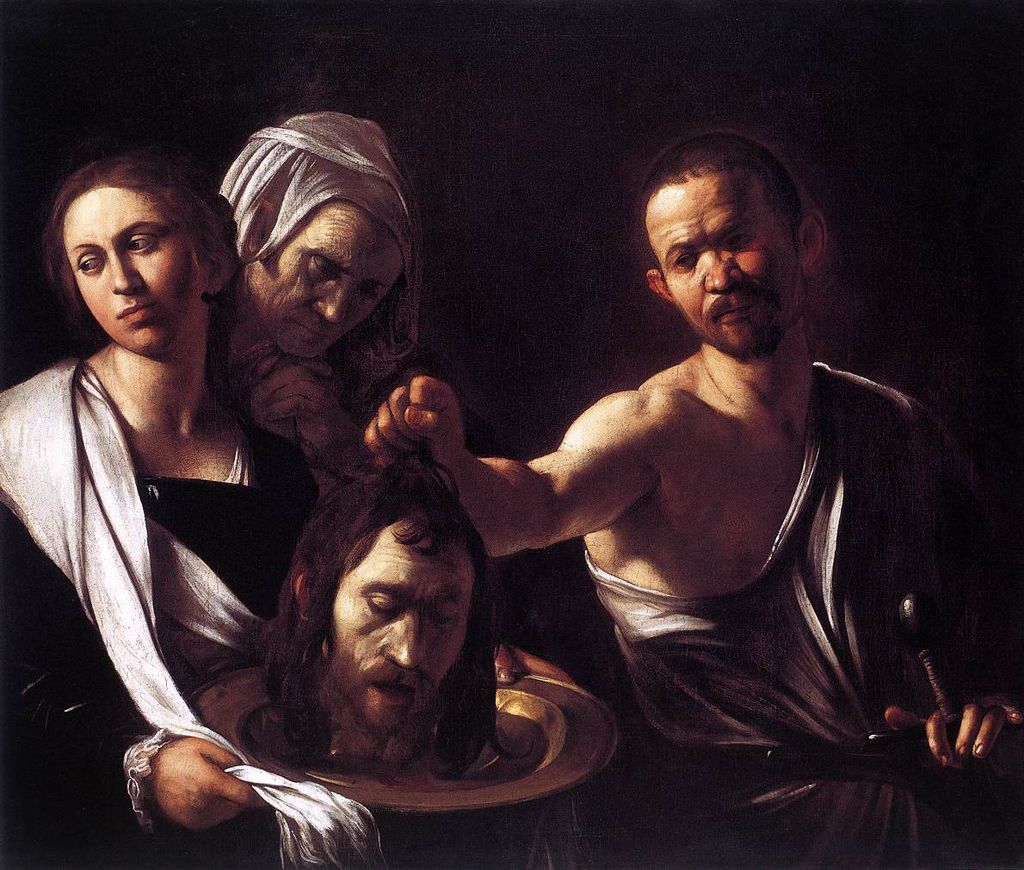
CaravaggioSalomeLondon.jpg
Caravaggio's Salome with the Head of John the Baptist, 1607-10
There is a lovely reflection upon the martyrdom of St. John the Baptist at Clutching My Rosary. "How beautiful, as St. John Chrysostom remarks, is this liberty of speech, when it is truly the liberty of God’s Word, when it is an echo of heaven’s language! Then, indeed, it is a stumbling-block to tyranny, the safeguard of the world, and of God’s rights, the bulwark of a nation’s honor as well as of its temporal and eternal interests. Death has no power over it. ... Thus the feast of the Decollation of St. John may be considered as one of the landmarks of the Liturgical Year."
 
How I pray for the courage of St. John and the eloquence of the Church Fathers. Yet I am grateful to share only the words of others. I recognize in myself, as St. Augustine says, "the ever-growing powerlessness of those souls to express what our Lord is working in them. Happy to have led the bride to the Bridegroom, let them learn to say with John: He must increase, but I must decrease." It is no wonder that two years ago, I shared a novena to St. John the BaptistToday, a Litany.
 
Lord, have mercy on us,  Lord, have mercy on us. 
Christ, hear us.  Christ, graciously hear us. 
God the Father of Heaven, Have mercy on us.
God the Son, Redeemer of the world, Have mercy on us.
God, the Holy Ghost, 
Have mercy on us. 

Holy Trinity, One God, Have mercy on us.
 
Holy Mary, Pray for us.
Queen of Prophets,
Pray for us.

Queen of Martyrs, Pray for us.

St. John the Baptist, Pray for us.
St. John the Baptist, precursor of Christ, Pray for us.
St. John the Baptist, glorious forerunner of the Sun of Justice, Pray for us.
St. John the Baptist, minister of Baptism to Jesus, Pray for us.
St. John the Baptist, burning and shining lamp of the world, Pray for us.
St. John the Baptist, angel of purity before thy birth, Pray for us.
St. John the Baptist, special friend and favorite of Christ, Pray for us.

St. John the Baptist, heavenly contemplative, whose element was prayer, Pray for us.
St. John the Baptist, intrepid preacher of truth, Pray for us.
St. John the Baptist, voice crying in the wilderness, Pray for us.
St. John the Baptist, miracle of mortification and penance, Pray for us.
St. John the Baptist, example of profound humility, Pray for us.
St. John the Baptist, glorious martyr of zeal for God's holy law, Pray for us.
St. John the Baptist, gloriously fulfilling thy mission, Pray for us.

Lamb of God, Who takest away the sins of the world, Spare us, O Lord.
Lamb of God, Who takest away the sins of the world, Graciously hear us, O Lord.
Lamb of God, Who takes away the sins of the world, Have mercy on us.

Christ, hear us. Christ, graciously hear us.
Pray for us, O glorious St. John the Baptist, That we may be made worthy of the promises of  Christ.
Let Us Pray. O God, Who hast honored this world by the birth of Saint John the Baptist,
grant that Thy faithful people may rejoice in the way of eternal salvation,
through Jesus Christ Our Lord. Amen.